The Simmons Center Unveils New Portrait of Dr. Ruth J. Simmons
A new portrait of Dr. Ruth J. Simmons, 18th President of Brown University, by Sedrick Huckaby was unveiled during Family Weekend. The portrait was commissioned by the President’s Advisory Council on the Ruth J. Simmons Center for the Study of Slavery and Justice to be put on permanent display at the Center.
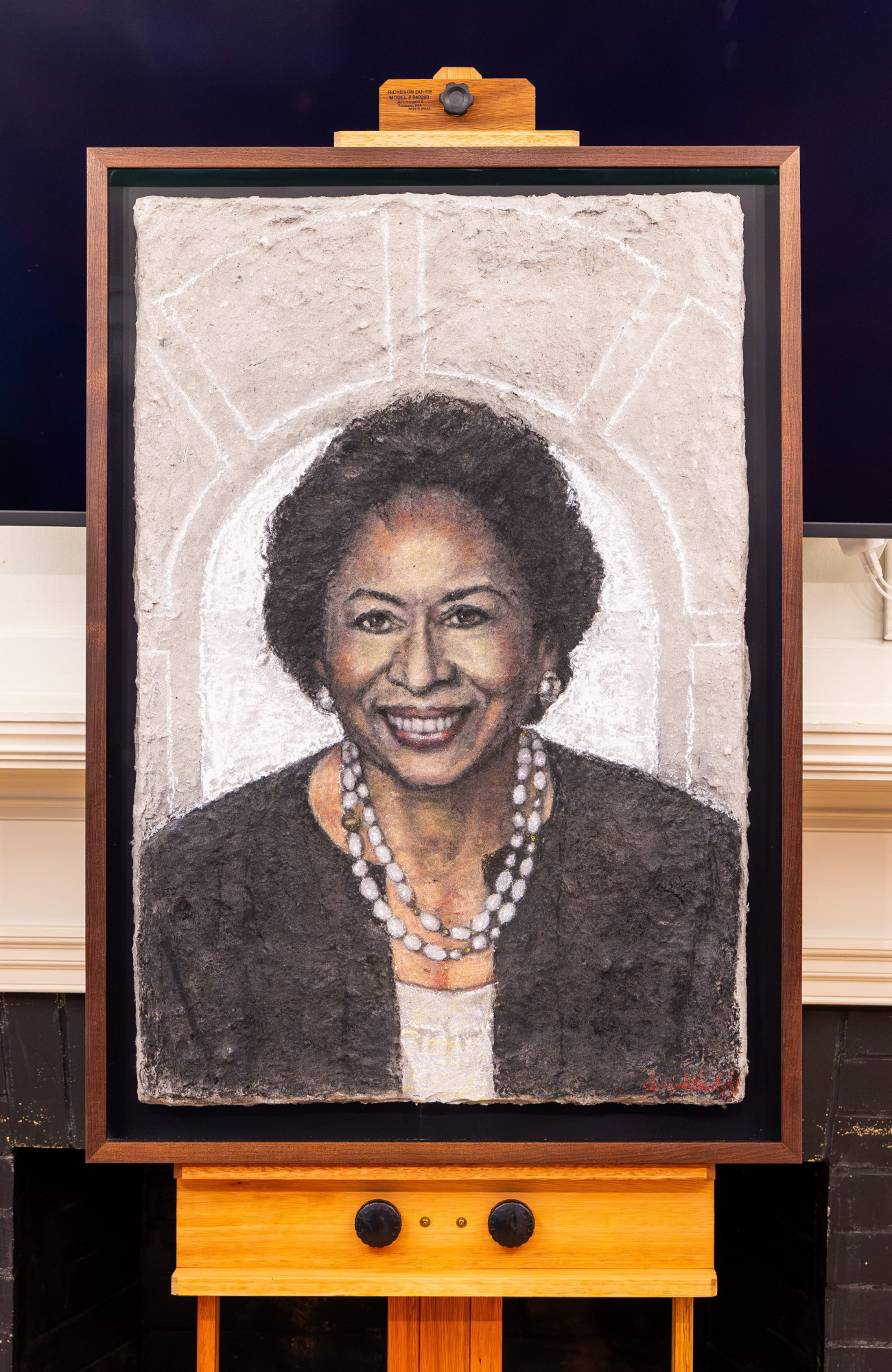
On a beautiful October afternoon, the Simmons Center bustled with anticipation as members of the President's Advisory Council of the Ruth J. Simmons Center for the Study of Slavery and Justice, Faculty Advisory Board members, and other special guests gathered to witness the unveiling of the newly-commissioned portrait of Dr. Ruth J. Simmons, the Simmons Center’s namesake.
During the 2026–2027 academic year, the Ruth J. Simmons Center for the Study of Slavery & Justice marks the 20th anniversary of the publication of Brown’s watershed Slavery & Justice Report and kicks off celebrating the 15th Anniversary of the Center. But the story of the Simmons Center starts much earlier than 20 years ago.
Dr. Simmons, the first Black female President of an Ivy League University, was President of Brown University from 2001 to 2012. During her first year as president, she began asking questions about the University’s ties to the Transatlantic Slave Trade. Not being satisfied with any of the answers she received, she appointed a Steering Committee on Slavery and Justice (SCSJ) in 2003 to explore Brown’s historical relationship to slavery and the Transatlantic Slave Trade.
“ When we started this study at Brown, I didn't think of it as being extraordinary at all… It was part of the work that I had started, earlier in my career, in a sense, and that is to just tell the truth — about who we are — and about history. ”
The Steering Committee, composed of Brown faculty, undergraduate and graduate students and staff, was chaired by Prof. James Campbell, then associate professor of American Civilization, Africana Studies and History at Brown University. The committee released its report along with a set of recommendations in October 2006. One of the recommendations was to “Create a center for continuing research on slavery and justice.” This recommendation was adopted by the University and the Center for the Study of Slavery & Justice (CSSJ) opened in 2012 with Prof. Anthony Bogues as the inaugural director where he has continued to serve ever since.
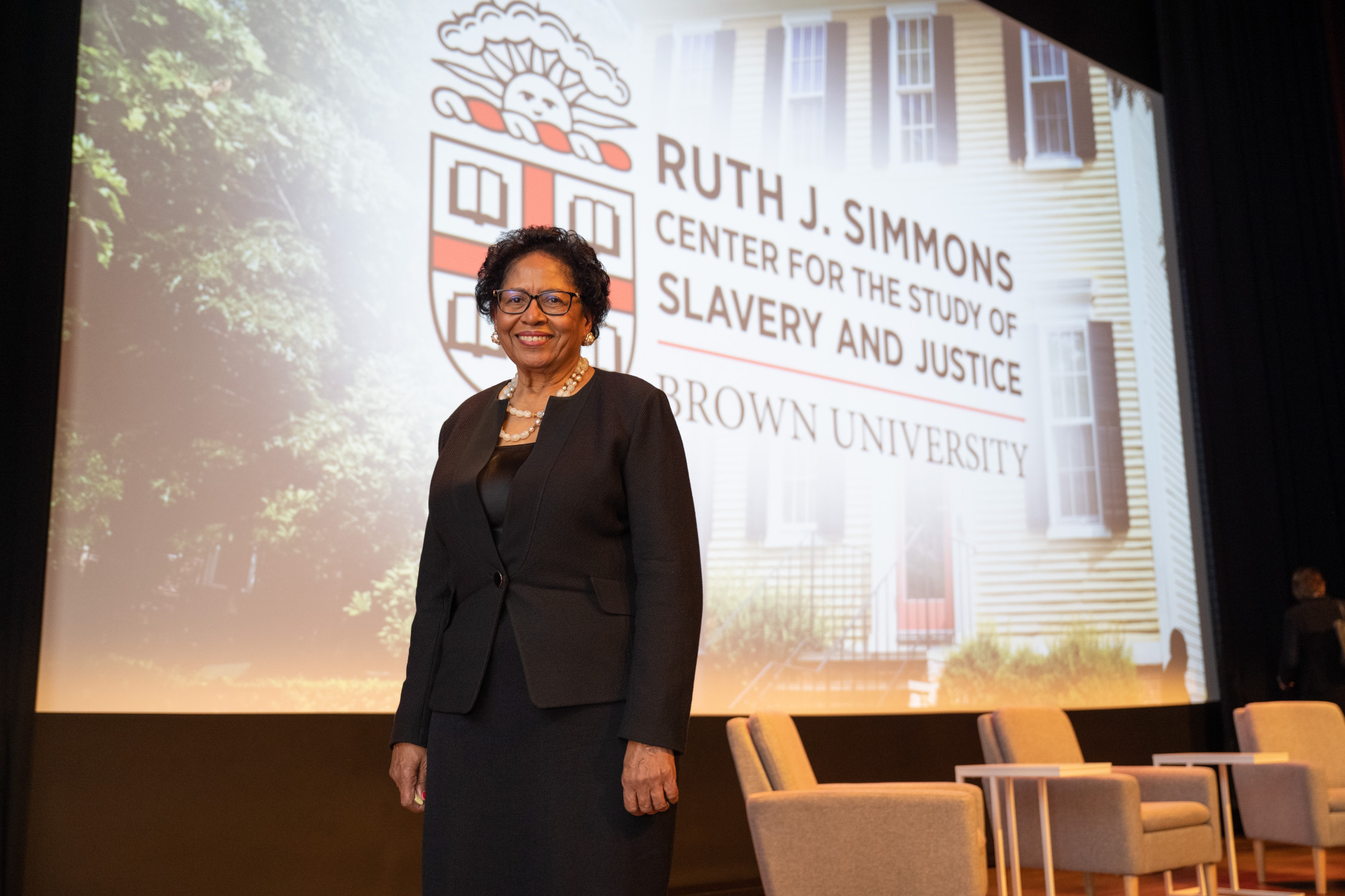
After the CSSJ was established, Dr. Simmons served as Founding Board Chair for the Center for several years and has continued to consult with Center leadership on key matters. In recognition of her outstanding leadership and dedication to the work of the Center, it was renamed in her honor in 2023, becoming the Ruth J. Simmons Center for the Study of Slavery & Justice.
Carrying Dr. Simmons’s name is an honor to the Simmons Center and its President’s Advisory Council. To properly recognize and remember her contributions, the board organized a sub-committee to identify an artist and commission a new portrait of Dr. Simmons to be displayed in the Simmons Center. After months of work to identify an artist who was up to the task, Advisory Council member Rakim Brooks ’09 found Texas-based artist Sedrick Huckaby and work on the portrait began.
Three years later, on Friday, October 23, 2026, the portrait was unveiled. The gatherings to celebrate Dr. Simmons and all those involved with the creation of her portrait kicked off a series of Family Weekend events hosted by the Simmons Center.
In her remarks during the portrait’s unveiling ceremony and viewing with the University Corporation, Dr. Simmons reflected on the moment she was asked to be President of Brown University. She “was very skeptical,” wanting to ensure that University officials understood who she was and would support her as president. She told them “You have to convince me that you know who I am,” and, in the aftermath of the backlash and questioning she received for looking into the University’s ties to racial slavery, they did. She was unwilling to give up her identity and values for a job and proudly reflected how “Throughout that period, the Corporation never backed down. They never said ‘Ruth, step back’. They never said ‘you should do it this way and not that way.’ They never, ever gave me to feel that they didn't understand who I was.”
You have to convince me that you know who I am.

Dr. Simmons’s unflinching dedication to the truth inspired the form that this new portrait would take. Portrait artist Sedrick Huckaby noted “I wanted the portrait to be on a stone because (it is) the representation of such a rock in the Black community.” While the surface of the portrait appears to be stone, the grey material is actually cellu-clay, a paper-based material. Huckaby described the materials used — both the cellu-clay and charcoal — as ancient materials that have been used in artmaking from time immemorial: paper and burnt wood. The burnt wood speaks to the more difficult parts of Black people’s and Dr. Simmons’ journeys, but the color added through his use of pastels “shows the depth of color within her and within Black folks in general… As a painter, when you mix all of the colors together, you get a beautiful brown.”
Simmons Center Director Prof. Anthony Bogues also emphasized Dr. Simmons’ enduring legacy in his remarks. He spoke of Dr. Simmons’ influence and importance not only to the Center and to Brown University, but to the entire field of education writ large.
She is one of the sharpest and most profound intellectuals around this question of education, and how education can work as a democratizing tool for the vast majority of people.

Twenty years after Brown’s Slavery & Justice Report was published, the landscape of institutions investigating their ties to racial slavery has shifted significantly. In the decade after Brown’s seminal work, a cascade of other institutions followed suit. Now, hundreds of other colleges and universities have done similar work, as have other organizations across the globe, modeled on the example set by Brown. However, more recently, institutions and organizations face political backlash against telling the truth about the world’s more difficult histories. In her remarks during the unveiling ceremony, Dr. Simmons told those gathered to “Keep believing in what this university can do for this community and for the world. Keep believing in what our students can do from all over the world. Keep believing in our capacity to do better no matter what, and to guide the world to a different and better future. Keep believing because it's true that Brown is the greatest university in the world.”

Members of the President’s Advisory Council on the Ruth J. Simmons Center for the Study of Slavery and Justice posed with artist Sedrick Huckaby and Dr. Simmons around her portrait. Photo by Mike Cohea.

Simmons Center staff, faculty, students and friends posed with Dr. Simmons around her portrait. Photo by Mike Cohea.
And so, the work of the Simmons Center continues. At a subsequent Family Weekend event, one of the major Public Humanities projects of the Center was discussed during a documentary film screening of “Uncorking the Bitter Truth: Slavery’s Legacy in Cape Wine” (2025). The film emerged out of “The Unfinished Conversations Series,” an archive of over 150 oral histories about individuals’ experiences with the legacies of racial slavery and colonialism across the Atlantic world. While "Uncorking" focuses on the stories and experiences of workers on wine estates in South Africa, the overarching oral history project explores the similarities and differences among communities impacted by slavery, including in the U.S., Jamaica, Brazil, Belgium, United Kingdom, Senegal, Democratic Republic of Congo and South Africa.
What lies ahead is something for the next generation of historians to write about. In the meantime, the Center continues to interrogate the histories of racial slavery and colonialism globally while also examining the many legacies of these systems. Drawing on the Center’s commitment to public humanities, a conference is being planned for spring 2027. The conference will highlight how public histories of slavery can help us understand, and respond to, a political moment shaped by a changing climate and by escalating questions of birthright citizenship, immigration detention, and deportation. The practices that sustain today’s regime, from the policing and surveillance of movement to the confinement and removal of migrants, descend from institutions inherited from slavery and reproduced across generations. As with all of the Simmons Center programs, this conference will bring together experts across disciplines: historians, legal scholars, practicing lawyers, artists, activists, organizers, and community members. In doing so, the conference asks what a public history of slavery owes the present, and how scholarship, advocacy, and community knowledge can work together to meet it.

Simmons Center Director Professor Bogues and Chair of the President’s Advisory Council on the Ruth J. Simmons Center for the Study of Slavery and Justice Spencer Crew unveil Dr. Simmons’ portrait. Photos by Mike Cohea.

Dr. Simmons smiles as she takes her first look at her portrait.

Dr. Simmons reflects on the significance of her time at Brown and the unveiling of her portrait for the Simmons Center.