Roots in the Center
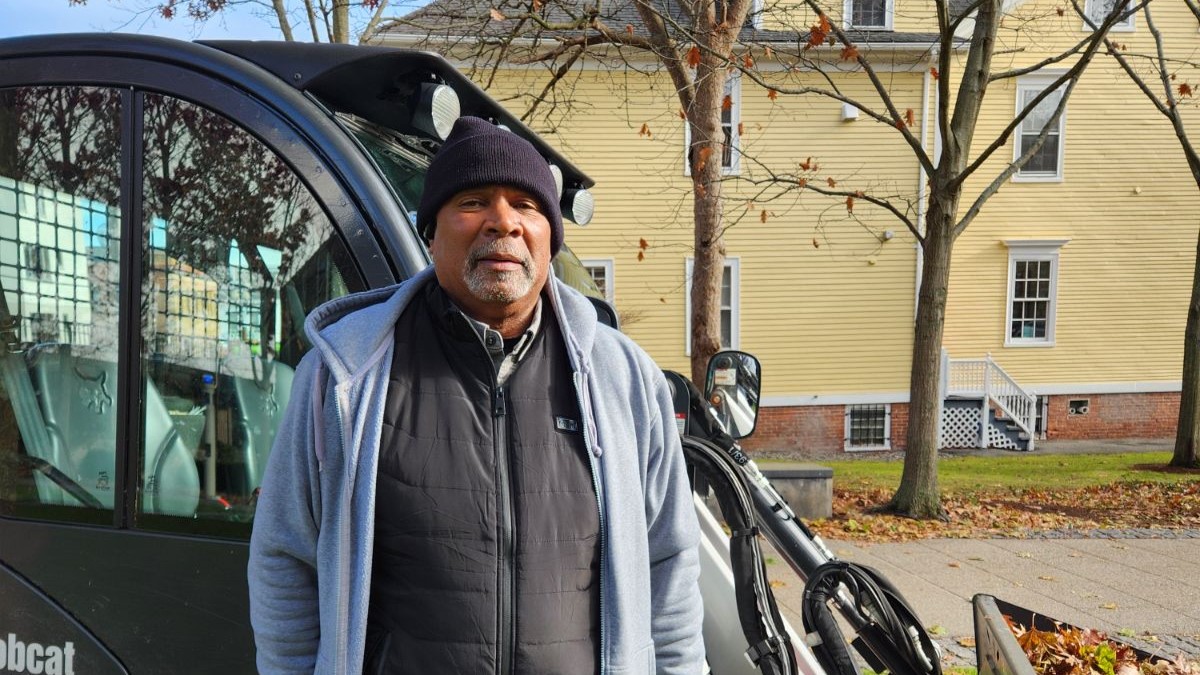
For the past decade, on most weekday mornings, Robert Farizer could be found on Brown’s campus, especially near the Ruth J. Simmons Quad and the Ruth J. Simmons Center for the Study of Slavery & Justice. Sometimes he would be driving a frontloader, other times sweeping up leaves, spreading ice melt, or pruning bushes. No matter what the work at hand was for the day, Robert always had time for a friendly wave and chat about the weather and weekend plans, or, more recently, his upcoming retirement.
Robert first became involved with the Simmons Center when it moved to 94 Waterman Street in 2014. At that time, Simmons Center Faculty Associate Prof. Geri Augusto, Senior Fellow in International and Public Affairs at Watson, sought to reclaim some of the underused spaces around the Simmons Center’s new building. Inspired by the gardens that enslaved people tended near their living quarters, Prof. Augusto’s vision was to create a Symbolic Garden of the Enslaved that would both honor and educate about the knowledges of enslaved and Indigenous communities. Prof. Augusto imagined the space as a kind of “anti-garden,” with a focus on alternative knowledge, the relationships between “the Red and the Black,” environmental justice, and the aesthetics and sense of beauty and joy of enslaved women.
Robert joined the project to help Prof. Augusto with some of the initial gardening work, the creation of sacred spaces such as the garden’s stone Dikenga dia Kongo, as well as annual planting and upkeep for many years.
Prof. Augusto recalls that “Robert was always more than just a dedicated caretaker.” The two of them often shared ideas about which plants and objects would best symbolize the spiritual and botanical practices of the enslaved, and where another touch of red or purple might signal for visitors the garden's underlying message of beauty and resistance, not just survival.
“I remember coming here to help Prof. Geri Augusto with the garden. I didn't know anything about it before,” Robert reflected when thinking about all the different plants and symbolic elements he helped to put into the garden, “but I learned a lot!”
This was exactly the intent of the garden. According to Prof. Augusto, “the garden should teach, it should inspire research, and it should invite people from around Providence to visit the Center.” After a decade working on the garden, Robert has helped to educate others on campus and in Facilities about the careful selection of plants and materials that are part of the space.
Robert’s care for the Simmons Center and Brown extended far beyond the boundaries of the Symbolic Garden for the Enslaved. He not only helped the Center with soil, mulch and plant questions, but also kept students, faculty, and staff members grounded in the community connections we all hold so dear. Robert always made a point to say “hello” to whoever was walking by. They may not have even known each other’s names, but he reflected that “meeting a lot of different people and learning about their ideas about life from all over the world has been a good experience for me. Open your ears, and you learn a lot.”
Treading New Waters

After 22 years as a Groundskeeper at Brown, Robert is looking forward to traveling and spending time with family in his retirement. He hasn’t made any firm plans yet, but laughed, noting, “I'll have plenty of time to think about it then!” Taking it day by day will be a nice change of pace for Robert, and the Simmons Center wishes him all the best in the years to come. And, as anyone who has ever stopped to chat with him will know, his summers will be filled with lots of fishing!