The Simmons Center hosted a book launch for The Imagined New (or what happens when History is a Catastrophe?), the new book edited by Prof. Anthony Bogues, Leora Farber, Zamansele Nsele & Surafel Wondimu Abebe.
Joining Prof. Bogues to discuss the book were panelists Prof. Brian Meeks, Professor of Africana Studies; Prof. Lindsay Caplan, Assistant Professor of History of Art and Architecture; and Prof. Geri Augusto, Senior Fellow in International and Public Affairs at the Watson Institute. The event was moderated by Prof. Philip Gould.
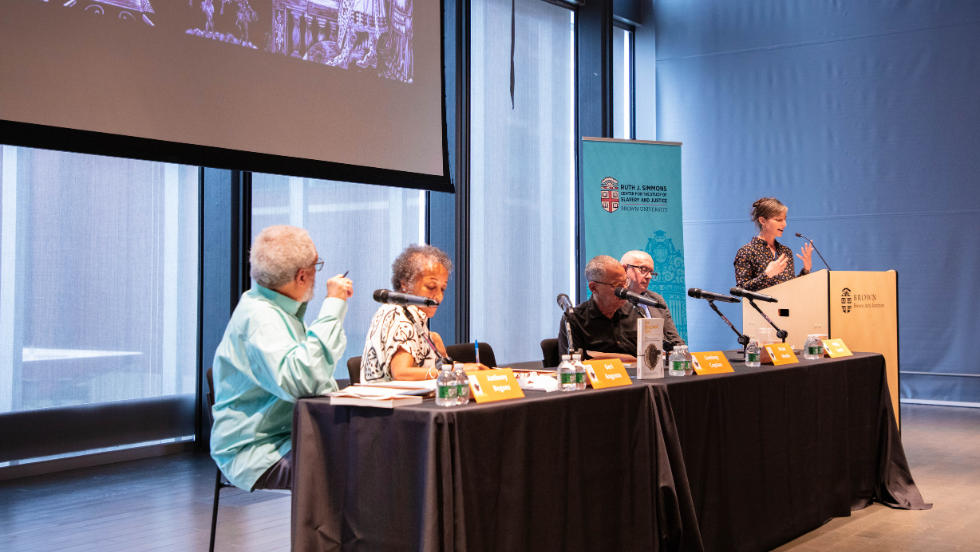
“The Imagined New offers a kaleidoscopic accounting of art as a catalyst of historical processes. It lays out different, even conflicting, ways that art functions with and against historical narratives, archival collections, images, and imaginaries . . . Taken together, the essays model what I see as the brilliant ambitions and achievements of the book: to see art as a site to produce these frictions, that epistemological disobedience that we have seen cited, as well as catalyze new relationships to history to reimagine it anew.”
Lindsay Caplan
Assistant Professor of History of Art and Architecture
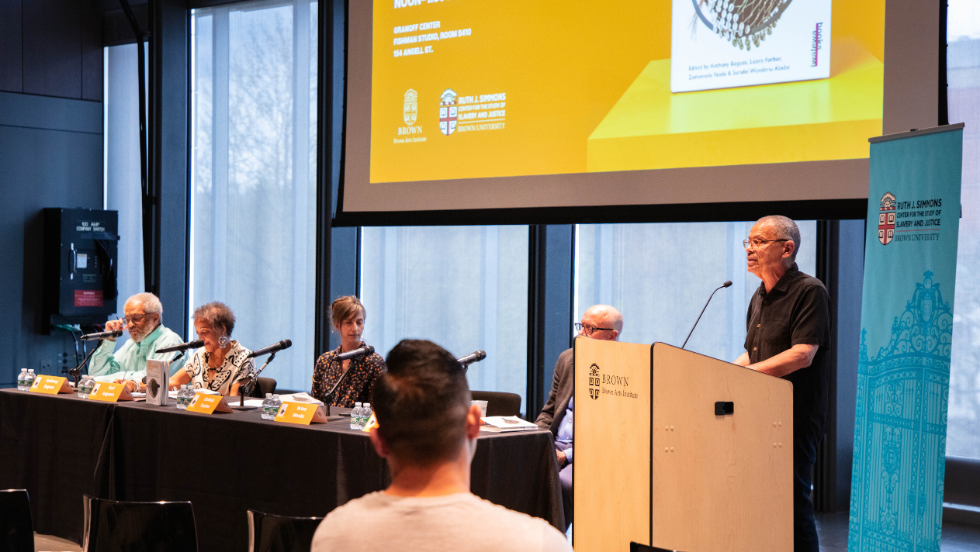
“As broadly captured in the pages of The Imagined New and in his monumental efforts at the Simmons Center for Slavery and Justice, and indeed, from the path he has followed since I knew him as a high school student in Kingston Jamaica, Tony Bogues is intimately concerned with the history, lived experiences, and prospective futures of the peoples of the African Diaspora. However, while many scholars might concentrate on one or two venues of the Diaspora, Bogues’ vision is truly diaspora-wide, with his interests and research spread across broad swaths, from Kingston to Addis Ababa, Johannesburg, Senegal and Barbados, and of course the sterling work of the Simmons Center in Rhode Island itself.
A second feature of his work is its exemplary interdisciplinarity. Tony starts out as a political theorist, but next thing you know he is hosting African film festivals; and then soon after, he is curating art exhibits; and I should mention that beyond this volume, and to drive home my point, there’s an accompanying one soon forthcoming on the Black Sonic Arts.”
Brian Meeks
Professor of Africana Studies