Although provocative, the title of this piece is a bit misleading. I am not saying “no thanks” to Thanksgiving. I truly enjoy the holiday. How could I not? It is a confluence of three of my favorite things: family, food, and football (although the order may vary depending on who is playing and who is cooking). Instead, this short reflection advocates for a critique and rejection of a settler colonial logic that ties the Thanksgiving holiday to an apocryphal past.
Thanksgiving became an annual national holiday in 1863, the same year that slavery was ended in the “rebellious states” and the grounds at Gettysburg were made hallowed in one of the nation’s most poignant moments of introspection. Like the Emancipation Proclamation and the Gettysburg Address, institutionalizing Thanksgiving constituted an attempt to redefine the American experiment by reexamining and restating the nation’s priorities.
Spurred by the existential crisis that was the Civil War, American leaders looked to recall a simpler time when the ideal of a nation “conceived in liberty, and dedicated to the proposition that all men are created equal” appeared less complicated, more universal, and, during a time of deep division, unifying. And to this end, the story of the supposed “first Thanksgiving” seemed apropos. The mythology of two distinct peoples coming together to enjoy the rewards of the American harvest (both literal and figurative) certainly seemed to fit the bill and would dominate not only how we reimagined this history, but also how we imagined ourselves.
Indeed, the nation that Lincoln proclaimed had been “conceived in liberty” and dedicated to equality could, thanks to the myth of the first Thanksgiving, trace its origins to that transcendent moment of unity when the Pilgrims and the Wampanoag supposedly supped together in brotherhood.
The problem with this distortion of the past is that it is not benign. By credulously telling and retelling this myth annually, we become complicit in the normalization and perpetuation of an absurd historical construction that rationalizes and justifies settler colonialism. It is to this that I say “No Thanks.”
If the unity and brotherhood that animated the “first Thanksgiving” was genuine, why did the descendants of those who supped together in 1621 experience starkly different outcomes? For it was Metacom, Ousamequin’s (Massasoit) son, who took up arms against those same Pilgrims who had communed with his father and whose supposed fraternity is consecrated every year on the fourth Thursday of November.
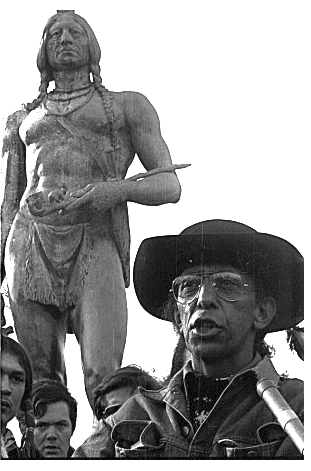
Courtesy of United American Indians of New England.
But the myth of the first Thanksgiving does more than just distort history because this fiction does not live only or primarily in the past. It is remembered and reenacted each year. And its underlying message is not one of unity and brotherhood but of dominance and disappearance. Indeed, the liberty and equality that Lincoln referred to in 1863 were wrought through two and a half centuries of theft and murder. And it is the celebration of this to which I say “No Thanks.” I am not alone in my rejection. My denunciation is informed by the actions, words, and obstinacy of my elders and ancestors who refused to allow lies about their past and present to go unanswered. It is my hope that, during this season of reflection, you too might consider your own bequest, for we are the sum of all that came before. It is this inheritance, the truths that have made and sustained us and not the myths, falsehoods, and lies, for which we offer our thanks.
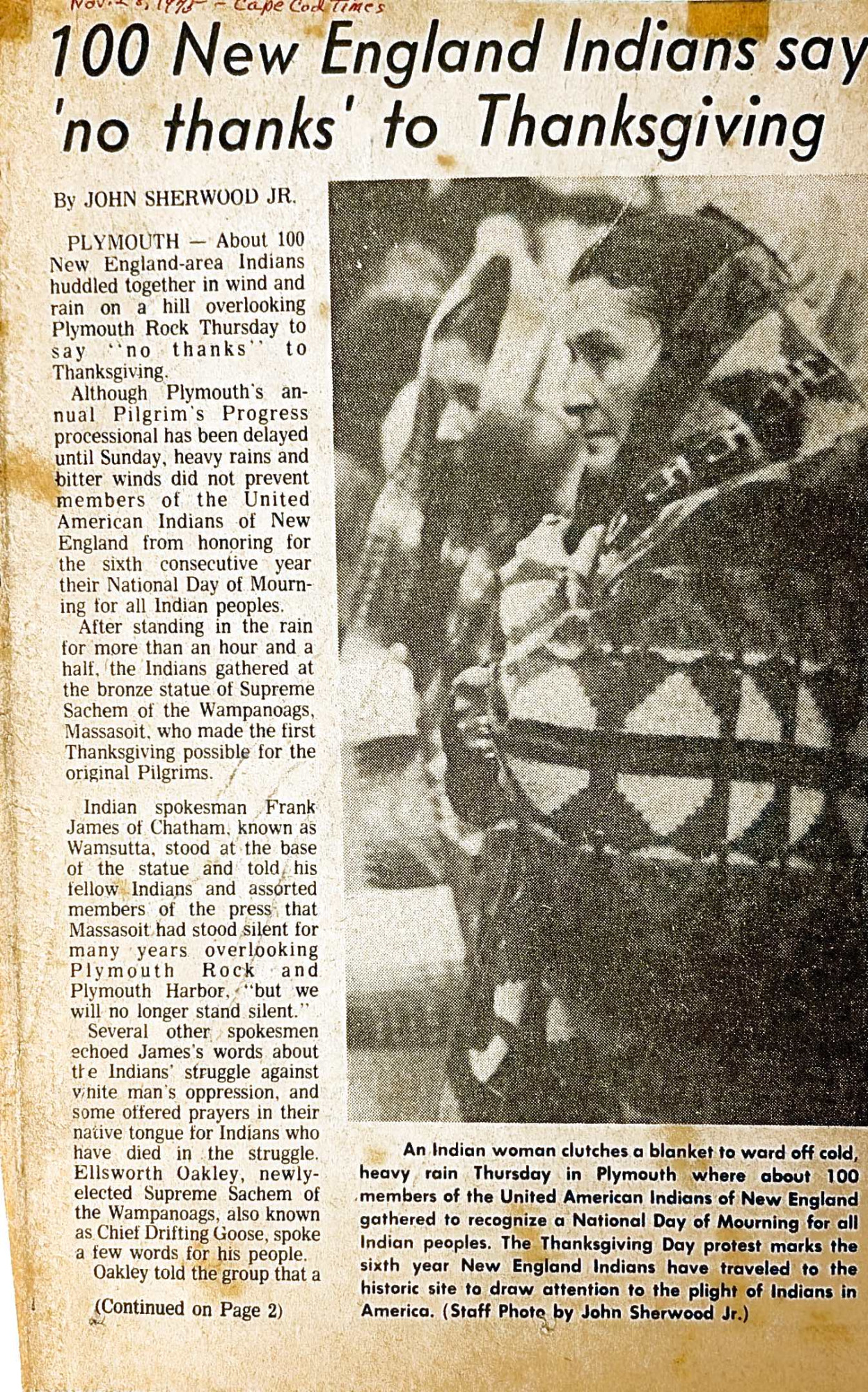
In 1970, during an event commemorating the 350th anniversary of the Mayflower’s sailing, Frank James (Aquinnah Wampanoag), also known as Wamsutta, was prohibited from delivering a speech he had been invited to give. James and an intertribal group of supporters organized as the United American Indians of New England reconvened at the base of the statue depicting Ousamequin. There, James delivered his speech to all who cared to listen. Thus marking the first observance of the National Day of Mourning. I invite you to visit the Reimagining New England Histories K-12 Curriculum website to learn more about this seminal event and to read James’ entire speech. But I will end here with just an excerpt from his opening.