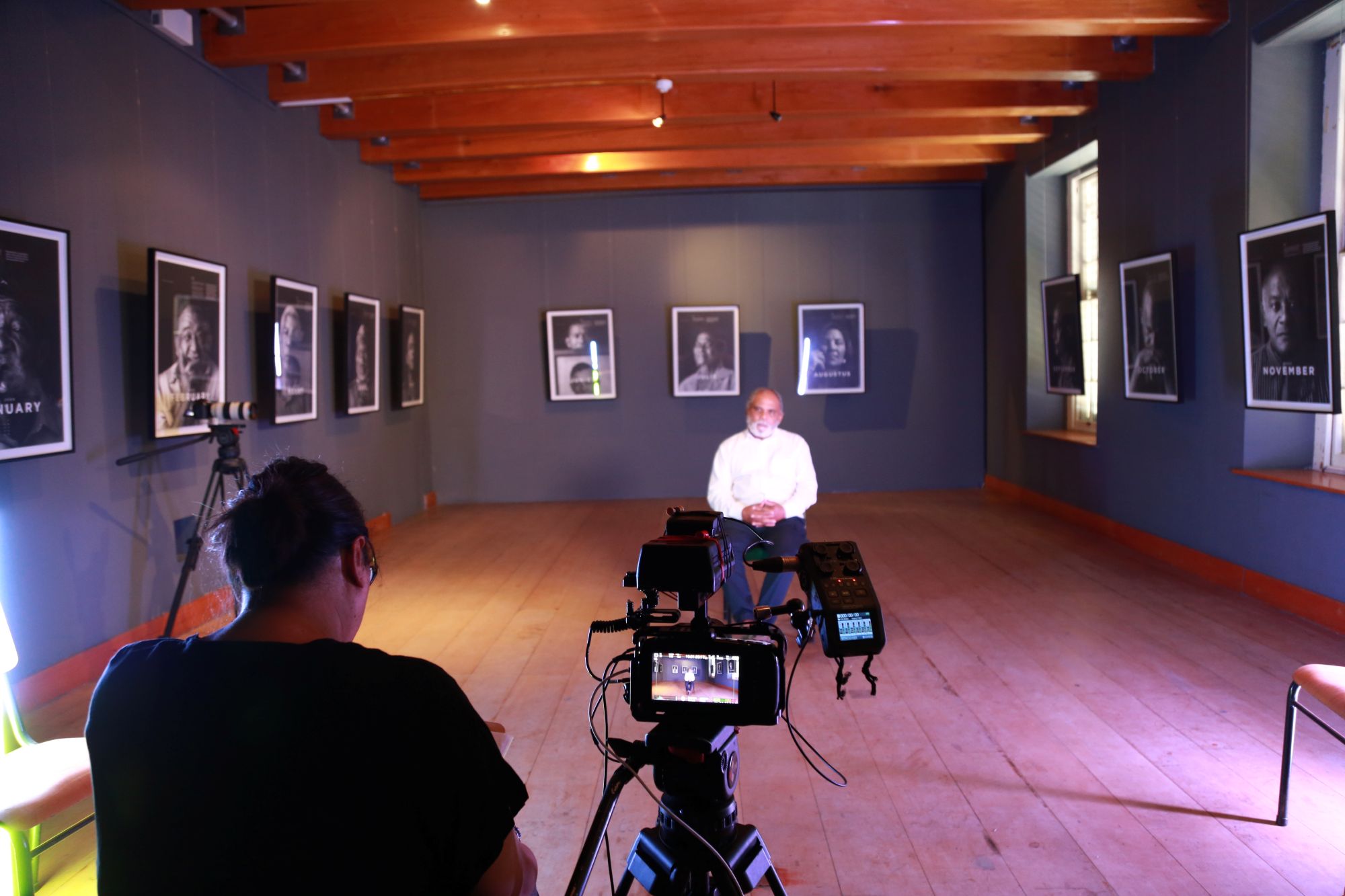
The Unfinished Conversations Series is an oral history, archival, and curatorial project that documents and shares community memories of how the legacies of slavery and colonialism continue to impact people’s lives today. Providing a platform for people to speak for themselves and tell their own histories is at the heart of Unfinished Conversations. With the support of Abrams Foundation and the Wyncote Foundation, The Unfinished Conversations Series has recorded over 200 hours of oral history interviews with the communities most impacted by the legacies of racial slavery and colonialism.
With contributions from people across four continents, this global collection challenges mainstream narratives that seek to whitewash the history of colonialism, racial slavery, and empire building and conventions of whose stories should be told and preserved. Led by the Simmons Center, the project is jointly organized with Global Curatorial Project (GCP) partners and their communities. Since 2021, partners have video recorded communities’ stories in Saint-Louis and Fouta, Senegal; Liverpool, United Kingdom; Africatown, United States of America; Rio de Janeiro, Brazil; Cape Town and the Groot Constantia Wine Estate, South Africa; neighborhoods surrounding Brussels, Belgium; Kinshasa and the Kimbanguist Church, Democratic Republic of the Congo; and Kingston and Charles Town Maroons, Jamaica.
Since its founding, the GCP network has shared a commitment to uplifting lesser-known community histories that speak to the lived experiences of enslaved and descendant communities, and challenge official state narratives. The stories of regular people, told in their own voice, have been largely absent in contemporary exhibitions on slavery. Conversations with communities in Liverpool and Senegal directly shaped The Unfinished Conversations Series. Community members were clear that they wanted to tell their histories themselves, despite the trauma associated with some of these stories. During a preparatory field visit in 2019, a community member in Senegal stated that documenting these stories requires talking to communities directly and “not to make history in their place.” A Senegalese leader of a prominent organization of descendants of slavery advised that the resharing of these histories was important, noting, “History is made up of things that give pleasure and other things that are painful.” Community members shared their hopes that these narratives presented through public-facing projects like the In Slavery’s Wake exhibition and archive at Brown University will help to make them more widely known and begin the process of eroding continually perpetuated false histories.
Individuals shared the community histories they felt were the most important. The cadences of storytelling—a pregnant pause; a searching for words; a shared, knowing laugh between interviewer and interviewee—create an intimacy between speaker and viewer that begins to shift the current understanding of racial slavery and colonialism. The interviewees’ candor allow a listener to begin to understand the human suffering caused by these violent and extractive systems, without scholarly or administrative jargon to mask these experiences.
Words are insufficient to express our immense gratitude to the communities that welcomed GCP members into their homes, neighborhoods, places of worship, and workplaces. In a world that continues to be so deeply shaped by the stratums and hierarchies created by colonialism and racial slavery, we do not take lightly the courage it took to share these personal, and often painful, histories. As the title of this initiative suggests, the work remains unfinished. We hope that the sharing of these stories through the archive at the John Hay Library, the In Slavery’s Wake exhibition (opening December 2024 at the National Museum of African American History & Culture, and other platforms will help to further understanding of how the past and present are so closely entwined We also hope that we have succeeded in making small steps toward acknowledging this history as it really was.