During the late-summer heat of 2020, in the midst of COVID and the aftermath of the murder of George Floyd, the Mellon Foundation created a new Just Futures grant line to fund “visionary, unconventional, experimental, and groundbreaking projects in order to address the long-existing fault lines of racism, inequality, and injustice that tear at the fabric of democracy and civil society.” Brown University, among other higher-ed institutions, was invited to propose projects with institutional partners. Awards would be few (10 nationwide) but large (up to $5 million) and competition would be intense.
Tony Bogues and Shana Weinberg at the Simmons Center quickly reached out to us at Mystic Seaport Museum and to colleagues at Williams College. The grant appeared a golden opportunity to draw upon existing relationships and build on early conversations about partnering on summer institutes, internships, and exhibits. The application process proved daunting. We needed to work collaboratively and remotely under pandemic restrictions, with new institutional partners, each in a different state and within its own organizational structure; a large Ivy League university (Brown); a small liberal arts college (Williams); a maritime museum (Mystic Seaport Museum); and a semester-long undergraduate program (Williams-Mystic Coastal and Ocean Studies Program). We had less than five weeks to craft a shared vision, compose a multi-year budget, create a compelling proposal, and complete all the paperwork.
Credit: Rythum Vinoben
Joining Tony and Shana in the long hours of zooming, writing, re-writing, and imagining the project were Tom Van Winkle and Sofia Zepeda (Williams-Mystic), Christine DeLucia (Williams College), Paul O’Pecko and myself (Mystic Seaport Museum), with extensive support and shepherding by our colleagues in grants management, finance, and sponsored projects. It takes a large and talented team to secure and steward a grant of this size and complexity.
Together we crafted the outline for an ambitious and novel project that drew together many threads. Our proposal for “Re-Imagining New England Histories: The Sea, Sovereignty, and Freedom” focused on African, African-descended, and Indigenous experiences as distinct but also intertwined, applied a maritime lens, and centered on the geographic area of the Dawnland (New England).
Once the grant was awarded in January 2021, figuring how to organize the effort was the first task. Tony and Shana at the Simmons Center drew on their deep experience to lead a small joint administrative committee to steer the work, consisting of the project co-directors from each partner institution. Soon, it became clear that the disparate project activities could develop concurrently through focused committees of community leaders, activists, scholars, and knowledge-keepers from Black and Indigenous communities as well as staff from the institutions. Committees organized on Publications, Exhibition, and Community Outreach, as well as a separate K–12 Education Committee, not funded by Mellon but such an important element that the Simmons Center covered the costs. During the first two years of the grant, we also held monthly Research Cluster zooms, sharing project-related scholarship within and across the partner institutions. The tangible “products” include a major gallery exhibit and companion basketry display, several publications, additional signage, African and Three Sisters gardens, and four collaboratively created K–12 curriculum units. The intangible results reside in those engaged with the project as committee members, fellows, interns, staff, students, visitors, and readers.
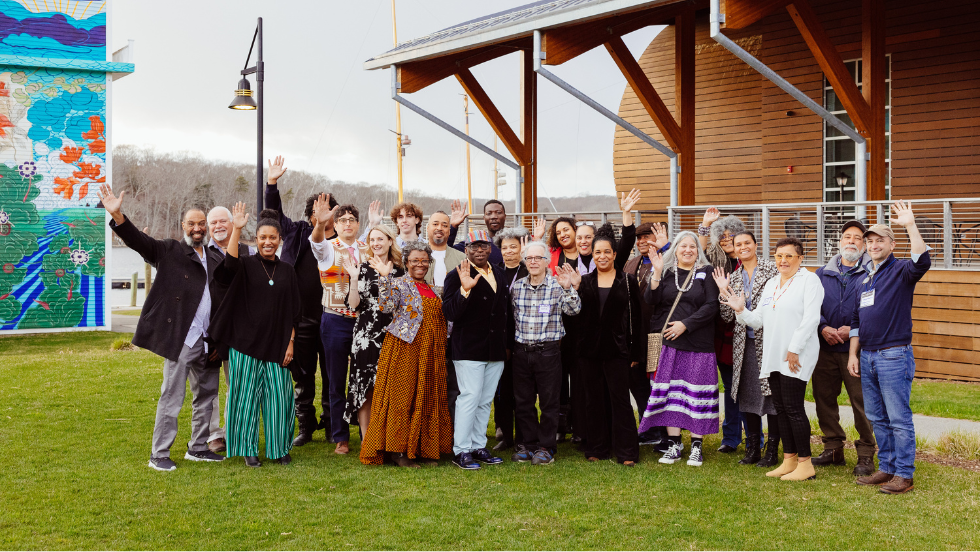
Perhaps the most intense, gratifying, and memorable RNEH activities were the annual “Gatherings” of institutional and community partners that drew us all together for conversation, learning, and sharing. The first was online during the pandemic, then successive ones were at Mystic Seaport Museum, a significant site in local Indigenous history and memory, across the river from the site of the 1637 Pequot massacre. Committee members shared updates, gained feedback, worked through critical questions regarding forward movement, and built community over meals catered by local Black and Indigenous chefs and caterers. Each day started with West African or Dawnland drumming and sometimes dancing and included time to reflect, walk along the river, or tour related exhibits between sessions. Additional support from Brown’s Native American and Indigenous Studies Initiative helped cover costs outside the Mellon grant.
Organizing all the work between the Gatherings happened through emails, newsletters, bi-monthly administrative group Zooms, regular check-in conversations, questionnaires, and shared documents. Shana Weinberg led the staff, fellows, and student-workers at the Simmons Center who kept us all in touch and updated.
That isn’t to say that the voyage was smooth, particularly the first year of the RNEH project. Due to the tight submission timeline, we were unable to reach out to tribal nations and Black community organizations while preparing the Mellon proposal. But only after Mellon announced the award publicly in January 2021 were we able to begin discussing the project with the very people whose stories and experiences the project was designed to “reimagine.” As a result, some organizations, tribes, and people refused to participate. Others were wary, but willing to engage, so we slowly began the process of working with, listening to, and building trust among our Black and Indigenous community partners.
The project has been a four-year journey to balance the organic and the individual with the institutional and organizational, moving forward at a pace to achieve set goals while also “moving at the speed of respect.” Often this meant pausing at a critical stage for reflection, additional conversation, and consultation. Sometimes it required shifting goals to meet community needs. Occasionally it meant taking a far different voyage than originally envisioned. And always, it resulted in richer, deeper, and stronger relationships than any of us could have imagined.
As we enter the final year of the project, nearly all the project “deliverables” have been completed and shared. But the relationships, conversations, and practices continue. Looking back, we can report to Mellon how we’ve achieved the Just Futures goals “to support fundamental and applied humanities exploration, in a manner that requires new forms of intellectual partnerships that are based in deeply reciprocal modes of collaboration, with the goal of shaping the future through the generation of bold new perspectives and imaginatively developed new knowledge.” May the ripples continue to flow outward as we do the necessary work in the years ahead.